

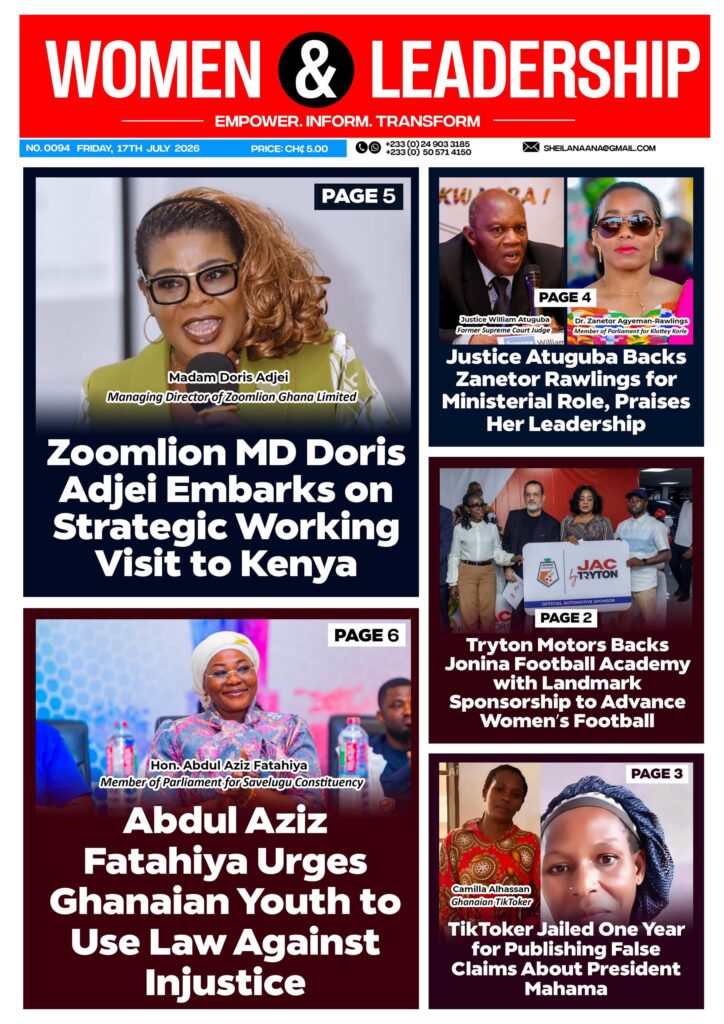
My keynote address at the Legal Edge Summit, University of Education, Winneba, delivered on behalf of the Mighty Minority Caucus of Parliament and the Minority Leader, Osahen Alexander Kwamena Afenyo-Markin.
REMARKS BY HON ABDUL AZIZ FATAHIYA DELIVERED ON BEHALF OF OSAHEN ALEXANDER KWAMENA AFENYO-MARKIN AT LEGAL EDGE SUMMIT
The Chairperson for this occasion, The Dean, Faculty of Social Sciences Education, The Head of Department of Geography Education, Executives and members of the Geography Students Association, Distinguished members of Faculty, Invited guests, Members of the press, Fellow students, Ladies and Gentlemen,
Good morning. It is my distinct honour to stand before this distinguished gathering at the Legal Edge Conference on the theme “Demystifying the Law: Equipping Ghana’s Next Generation of Leaders with the Legal Edge.”
I bring you warm greetings from the Mighty Minority Caucus of Parliament and on behalf of Osahen Alexander Kwamena Afenyo-Markin, Minority Leader and Member of Parliament for this constituency, who regrets being unable to join you due to pressing national duties and asked me to deliver this address on his behalf.
Your letter of invitation described this conference as a student-centred legal literacy initiative, built to place practical legal knowledge in the hands of young people for their leadership, career growth and responsible citizenship. It does not ask you to become lawyers. It asks you to begin owning, right now, the law that will one day protect your wages, your business and your citizenship. I commend the entire Department of Geography Education and the Executives of Geography Students Association for organising this conference.
Setting the Pace: The Sources of Ghanaian Law
Ladies and gentlemen, my dear students, where does Ghanaian law actually come from, and what gives it the right to bind you? Article 11 of the 1992 Constitution answers that question. Article 11(1) names five sources, and everything else I say today rests on them.
First, article 11(1)(a): The Constitution itself. Article 1(2) makes it the supreme law of Ghana; any inconsistent law is void to that extent. Article 2(1) permits any citizen ask the Supreme Court to declare an enactment, act or omission unconstitutional. Tuffour v Attorney-General held that the Constitution must be read broadly and purposefully, as a living organism, defensible by any citizen whether or not their personal interest is at stake. Also, in the case of New Patriotic Party v Attorney-General (31st December Case), the court held that public money could not be spent glorifying the overthrow of constitutional government.
Second, article 11(1)(b): enactments of Parliament. Article 93(2) vests legislative power in Parliament which gave us the Commission on Human Rights and Administrative Justice Act, 1993, protecting citizens against abuse of power; the Courts Act, 1993, which structured our court hierarchy; and the Electoral Commission Act, 1993, which has organised every credible election since.
Third, article 11(1)(c): Orders, Rules and Regulations made under the Constitution. Article 11(7) means such an instrument takes effect only after twenty-one sitting days before Parliament, unless annulled by two thirds vote. That is not a technicality: Osahen argued exactly this before the Supreme Court himself. In 2015, Benjamin Eyi Mensah, a fisherman from Eyipey right here in Winneba, came to him after the Electoral Commission rushed that year’s district assembly nominations through in a single day, under an instrument that had not completed its own twenty-one-day journey through Parliament.
The Court agreed it was immature, inconsistent with articles 45(b) and 51, and ordered the process restarted. A fisherman did not need a law degree to know something had gone wrong; he needed only the courage to say so, and a lawyer willing to stand beside him. That, more than anything else, is the true value of legal literacy: it empowers ordinary people to recognise injustice and assert their rights.
Fourth, article 11(1)(d): existing law. Article 11(4) carries forward laws already in force when the Constitution took effect, so the nation did not wake on the 7th of January 1993 to a legal vacuum. The Criminal Offences Act, 1960 still defines crime in this country. The Sale of Goods Act, 1962, still governs every purchase you make from a shop. The Intestate Succession Law, 1985, still decides how a Ghanaian family’s property is shared when a loved one dies without a will.
Fifth, article 11(1)(e): the common law. Article 11(2) gathers the common law, the doctrines of equity, and the rules of our own customary law, the law of our chiefs, our stools and skins and our lineage systems.
Hold that structure in mind. We are about to test it against three problems every emerging leader in this hall will face.
Navigating Labour Rights
Ladies and gentlemen, my dear students, every one of you will, sooner or later, stand on one side or the other of an employment relationship: most will begin as teachers posted by the Ghana Education Service, while some will eventually rise to become headteachers, directors, or other officials representing the employer.
Article 24 gives every person the right to work under safe, satisfactory conditions, to equal pay for equal work, to rest and leisure, and to join a trade union, a constitutional right no employment contract can lawfully strip away. The Labour Act, 2003, Act 651, empowers that rights its working detail. Section 63 bars dismissal for gender, ethnicity, religion, political opinion, pregnancy or disability. Ghana has been a member to the International Labour Organisation since 1957, so this architecture also honours commitments Ghana made to the world.
Ladies and gentlemen, my dear students, not every dismissal that feels unfair is, in law, unfair termination. Charles Afran and Others v SG-SSB Limited distinguished statutory unfair termination under Act 651 from common law wrongful termination, tied to what your actual contract says. National Labour Commission v Barclays Bank Ghana Limited held that our law did not abolish the common law freedom to terminate employment without assigning a reason, once proper notice or pay in lieu is given. Baiden v Graphic Corporation confirmed that redundancy under section 65 of Act 651 must arise from genuine changes in technology, structure or size, never as cover for removing an inconvenient employee. Any dispute goes first to the National Labour Commission, before it ever reaches a courtroom.
My dear students, here is your takeaway. As a future teacher or public servant, know that section 63 protects you and Article 24 stands behind you. As a future head of department or manager, your authority travels with obligation: proper notice, a written contract, and the discipline to remember that fairness at work is not simply good manners. In Ghana, it is good law.
Corporate Law, and Why It Belongs to Every Geographer
Ladies and gentlemen, my dear students, you cannot study land in this country and remain a stranger to company law. Under article 257(6), every mineral in, under or upon land in Ghana is the property of the Republic, held by the President in trust for the people. Yet companies, not the President, do the digging. Under the Minerals and Mining Act, 2006, Act 703, a mineral right can only be granted to a body corporate. Every mining concession you will ever plot on a map is, beneath its topography, a corporate law document.
That Act also protects the people whose land sits above those minerals, held under customary tenure recognised in article 267 as stool and skin lands. Sections 72 to 75 of Act 703 require fair compensation for disturbance, loss of use and lost crops. Ground rent is payable annually under section 23, royalties of five percent go to the State, and article 268 requires Parliament to ratify any mineral right agreement before it takes effect.
Even the Muni-Pomadze wetland on our own Aboakyer hunting grounds carries this weight: a Wetland of International Importance under the Ramsar Convention since 1992, and protected at home under our own Wetlands Management Regulations. That, too, is geography. It is also, unmistakably, law.
My dear students, Salomon v Salomon, decided by the House of Lords in 1897: intimated that once properly incorporated, a company becomes a person in its own right, distinct from those who own and run it. That is why, under our Companies Act, 2019, Act 992, any Ghanaian of eighteen and above can incorporate a company and if the venture fails honestly, not automatically lose personal property alongside it. Our own Supreme Court refined that rule in Morkor v Kuma, where Justice Sophia Akuffo (As she then was) held that a company’s directors remain legally separate from it unless there is fraud or a deliberate attempt to evade an obligation, in which case our courts will lift the corporate veil.
Ladies and gentlemen, my dear students, here is your takeaway. The company you may one day form, or study on a map as a mining concession, is not a shield for wrongdoing. It is a serious legal instrument, answerable, in the end, to the same land and people your discipline exists to serve.
Professional and Leadership Responsibility
Ladies and gentlemen, my dear students, Labour law and corporate law are the hardware. Professional responsibility is the software that decides whether that hardware builds or destroys. Before you ever mark an exercise book as a qualified teacher, the law will already have registered your name. The Education Regulatory Bodies Act, 2020, Act 1023, established the National Teaching Council, and section 67(1) states plainly that no person shall practise as a teacher unless registered under the Act. Teaching in Ghana is a licensed profession, in the same family as law, medicine and accountancy.
In Awuni and Others v West African Examinations Council, WAEC cancelled students’ results and banned them from future examinations over suspected malpractice without ever calling them to answer. Our Supreme Court struck that decision down on one of the oldest principles in our law: natural justice, that no person should be condemned unheard. Before you discipline a pupil, hear them. Before you report a colleague, verify your facts. Before you judge a person’s character on a rumour, ask for their side.
Closing
As I conclude, let me draw these threads together. Perhaps you came expecting a lecture about maps and land use. Instead I have asked you to see your discipline through a different lens: the law that governs the land you study, the labour you will one day give or receive, and the profession many of you are about to be licensed into. That is what it truly means to demystify the law, the invisible geography beneath your geography, the boundary lines that determine who owns what, who owes what, and who answers to whom.
Know your rights under Article 24 and the Labour Act. Understand the power, and the limits, of the corporate form that will one day stand between you and the land you study. And above all, carry the one thing no statute can legislate into you: integrity, fairness, and the courage to defend what is right, even when no one is watching and nobody is thanking you for it.
I congratulate the Geography Students Association for the vision behind this conference, and I congratulate each of you for showing up today in search of not just knowledge, but an edge. Go out, and use it well.
Thank you for your kind audience, and God bless you all.